
Effectively matching a clinician to a job is the highest-leverage work a staffing agency does.
You already earned the right to fill the job. You already have a clinician in your database. The match is the magic that brings the two together.
Getting the match wrong has serious consequences:
- At best, pitch the wrong job and get ignored.
- More likely, pitch the wrong job and lose credibility, lose subscribers, and burn through your database.
So what makes a match "good"? At Nomad, we believe it's the combination of two factors — intent and qualification.
Intent
Is the clinician actually interested in the job? If they win the offer, will they accept the position?
Qualification
Can this clinician actually perform the job's duties? Will they win an offer if presented to the client?
If you can answer these two questions, you can make a good match. But how?
In this post, we'll explore how Nomad solves for Intent. In a follow-up post, we'll dive into Qualification.
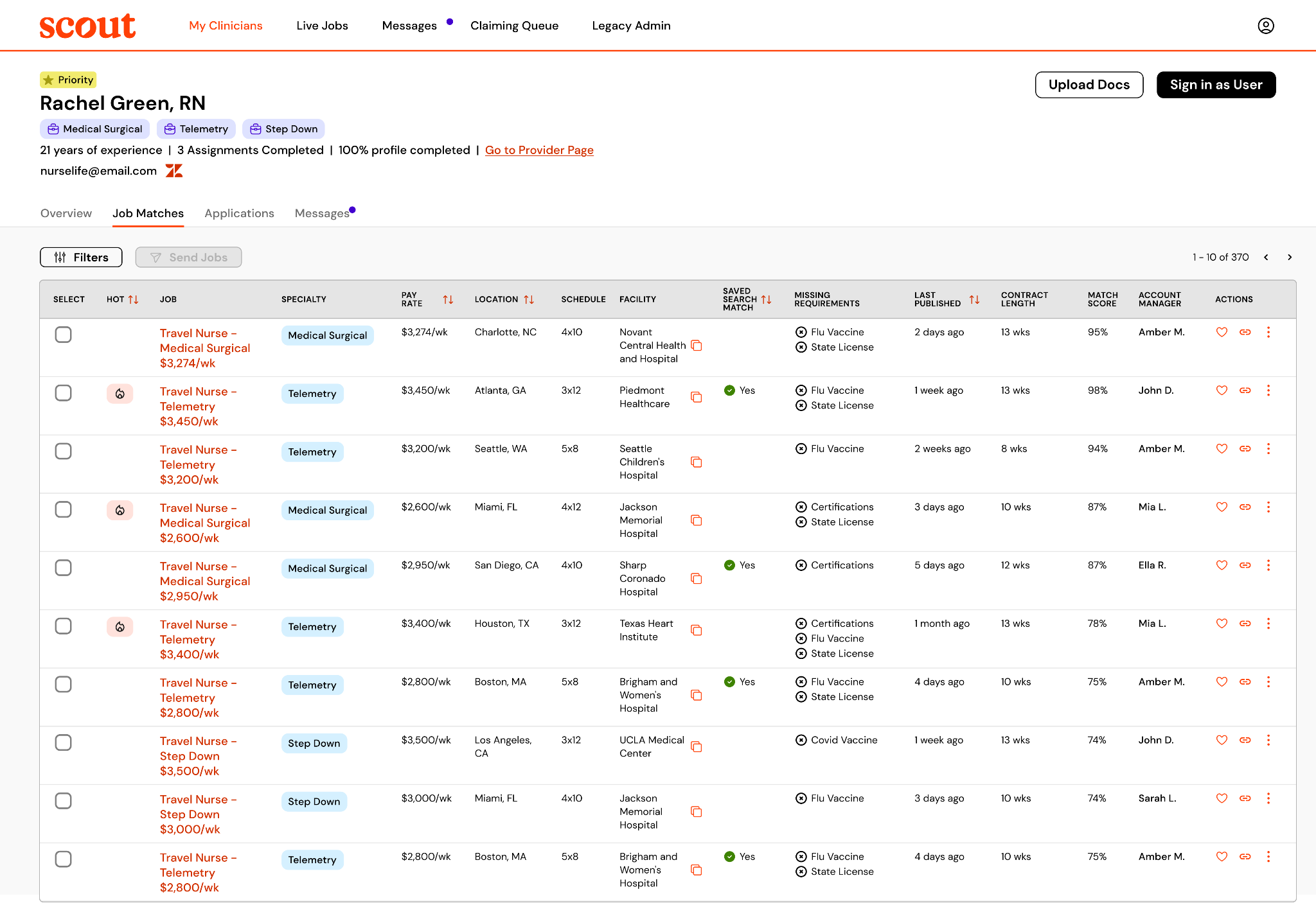
The intent capture problem
Historically, recruiters make the match through conversations, tribal knowledge, and intuition. They collect preferences through phone calls or text conversations, (hopefully) record this in the CRM, and then produce matches from there. Experienced recruiters know that an ICU nurse may be willing to work stepdown — or that a clinician says they'll only work Days, but will actually work Nights if the pay is high enough.
This approach is effective, but conditional on two things:
- You have a clinician who is willing to engage with your recruiter.
- You have an experienced recruiter who understands the nuance of stated versus implied preferences.
Of course, we know that clinicians are more and more unwilling to pick up the phone as they're barraged by automated outreach. And we know you can't scale your business simply by leaning on your experienced, rockstar recruiters.
It's a catch-22: you can't get a clinician to talk to you unless you pitch them a compelling job — and you can't pitch a compelling job without talking to them first.
The good news: Nomad has solved for this.
How Nomad captures intent
Our system, like others, lets clinicians define their preferences and get alerted when matching jobs hit the platform. We call these explicit preferences.
But capturing explicit preferences depends on a clinician taking the time to define them — and assumes the explicit preference is their actual preference. Experienced recruiters know that what a clinician explicitly shares is often not the full picture.
So Nomad built a system to capture revealed preference as well. Every clinician interaction on the platform — jobs viewed, emails clicked, SMS clicked, applications started, and more — is captured. Those interactions create a map that, stitched together with every other similar clinician, reveals a clinician's true preferences.
Under the hood, Nomad uses the same AI graph technology that Netflix uses to suggest your next show and Meta uses to suggest your next friend. We've stitched together a graph spanning millions of interactions to produce matches based on the clinician's actual behavior.
Picture every clinician and every job on Nomad as a dot. Every time the two touch - a job viewed, an email clicked, an application started - we draw a line between them. Do this across hundreds of thousands of clinicians and jobs and millions of interactions, and you get an enormous web. The shape of that web is not random: it encodes which jobs attract which kinds of clinicians, and which clinicians behave alike.
The real trick is turning that tangled web into something we can measure. For every clinician and every job, we compute a short list of numbers (an "embedding") that acts like a set of coordinates, dropping each one onto a shared map. Clinicians and jobs that land near each other share something meaningful, even if they've never directly crossed paths.
When a brand-new clinician arrives on the platform, we don’t have any signal for her - so we serve the most popular jobs. As soon as she gives us a single signal (say, the states she'll work in), the network kicks in. The clinician is instantly wired into the whole web and placed somewhere sensible on the map. The more she tells us, and the more she clicks, views, and favorites, the sharper her coordinates become - until they capture a surprisingly rich picture of who she is and what she's really after.
Once everyone lives on the same map, matching becomes a distance problem. To answer "will this clinician be interested in this job?" we simply measure how close their two points sit. Close together is a strong match; far apart means keep looking. No phone call required, and no veteran recruiter needed to read between the lines - the geometry does the decoding, at a scale no human team could ever reach by hand.
So we have explicit preference and revealed preference. Combined, they comprehensively answer the Intent question: "will this clinician be interested in the role?"
This is what breaks the catch-22. You don't need the clinician to pick up the phone — their clicks already told you what they want. And you don't need a rockstar recruiter to decode stated versus implied preference — the platform does it for you.
But that's only one half of the equation. In our next post, we'll explore how Nomad answers the Qualification question: "can this clinician be presented for the job — and will they win an offer for it?"